

Article
Hardwood Haven
Friday, August 8, 2026 from Floor Covering Weekly
More insulated from affordability issues, category performed in a difficult year
By Suzy Krogulski
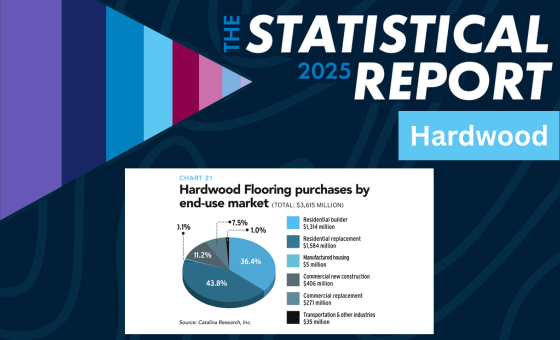
Hardwood offerings had a standout year in 2025, according to Catalina Research.
Catalina Research found that, in 2025, “Wood flooring experienced a relatively sharp sales increase in dollars and square feet in 2025. Wood flooring manufacturer dollar sales could have increased by 3.7 percent to $3.6 billion. Square foot sales could have risen by 3.3 percent to 1.2 billion. In 2025, wood flooring’s share of total floor covering dollar sales could have been 11.7 percent and 4.9 percent of total square foot sales. This is up from 11.3 percent and 4.7 percent, respectively, in 2024.”
Yet wood was not immune to challenges, such as affordability issues, an unstable housing market and competition from lookalike options. However, it’s appeal as “aspirational” gave it a leg up thanks to consumers less affected, or unaffected, to challenges posed by the economy.
Indeed, Aarthi Swaminathan, MarketWatch’s personal finance reporter, highlighted a K-shaped economy making housing difficult for consumers in lower income brackets, and easier for higher, in her article “What affordability crisis? Rich home buyers are powering the housing market.” She noted jumbo mortgage rates offered by banks with consumer assets under management as well as the AI stock market boom as powering participants’ purses as factors. She also highlighted a larger inventory of luxury houses.
Hardwood resonates with these consumers. “If they have the money to remodel, they have the money to invest in their homes — that section of the consumer base also values what hardwood brings: its authenticity, the realism and how the [product’s] going to perform,” said David Moore, vice president of product management, Mohawk.
And, even if the consumer is unaffected by the economy, it still may sway their behavior. “Consumers are becoming more selective, often choosing products that offer lasting value over short-term savings. Growth in hardwood reflects confidence in home improvement spending and supports domestic manufacturing, distribution and skilled installation,” said Drew Hash, president and CEO, Southwind Floors.
Ultimately, wood’s performance boils down to who has purchasing power right now. “It clearly shows that the high-end consumer is still purchasing, updating and spending money on their homes and will still choose premium products. This shows a shift away from price-driven purchases toward quality and long-term value,” said Danielle Lancianese, hardwood director, Shaw Floors.
Precarious Conditions
Despite hardwood’s strong showing, the sector still felt the challenges posed by difficulties in the market. Milton Goodwin, vice president, product management, hardwood, AHF Products, highlighted energy cost and interest rates both increasing as key challenges.
Agreed Michael Martin, vice president, sales and marketing, Peachey Hardwood Flooring, noting the effects of the rate stall. “We are not seeing the predicted ‘rate thaw’ yet that would release substantial pent-up renovation demand. Projects that were put on a ‘wait-and-see’ hold in 2024 and 2025 look to remain there in 2026.”
Plus, Moore noted, additional challenges are arising from competition in other categories.
While growth is there, said Bjelin’s CEO, Fredrik Alfredsson, “The market remains challenging, particularly in new construction. The segment is still under pressure due to high interest rates, which we see globally but especially in the U.S. Many homeowners would like to move but are holding on to existing mortgages, which keeps the market cautious.”
Thus, wood’s growth, said Al Boulogne, senior vice president, residential product and marketing, Mannington, “parallels what is happening in the economy. High-end builders have been sustaining a good rate of construction projects that is outpacing the mid-market price points.”
Alongside high-income earners, consumers who are opting for hardwood are buying with great consideration and intention. Lancianese explained hardwood’s growth demonstrated consumers are practicing thoughtful spending. “While there have been fewer new construction projects and renovations have slowed, consumers in the mid- to high-end segments still valued premium, high-luxury materials,” she said.
Added Goodwin, “What we are seeing is our premium products are doing well — the people that have the disposable income are less affected.”

Roots for Growth
Martin credits the category’s growth to hardwood’s appeal. “The 3.7 percent growth is a testament to hardwood’s enduring value, especially when you consider the headwinds navigated in 2024 and 2025. With a locked-in housing market and elevated interest rates, a lot of the industry expected flat or even slightly declining volume.”
John McElroy, merchant, MSI, noted this growth is significant given the recent expansion in resilient, which mimics wood’s look and texture. He sees a natural shift back to wood from the consumers who once tried resilient. And while the resilient will continue to grow, McElroy said, the hardwood category has potential to grow as well.
Indeed, said Robert McNamara, vice president marketing and sales, Sheoga Hardwood Flooring, “Hardwood will capture [market share] back from resilient.”
After all, hardwood appeal is such that consumers see it as a goal. McElroy observed, “There has always been a strong foundation of hardwood business for those ‘hardwood’ enthusiasts’ that want hardwood flooring, will save and patiently wait for it, and understand how to care for it.”
Plus, hardwood’s styling is claiming consumers’ attention, noted McNamara. “White Oak is still hot. Herringbone, Chevron and Parquet patterns are [popular] to add character and add uniqueness to the projects,” he said.
In addition, said Martin, texture and sheen shifts will capture consumers. He explained that they are seeking out surfaces such as light wire-brushing and ultra-matte, low-luster finishes. “They want the wood to look and feel raw and organic, which ties directly into the broader biophilic design movement,” he said.
These design changes help keep the value of hardwood high. “In a relatively subdued housing market, it is more important than ever for both new builds and renovations to differentiate themselves. A real wood floor adds clear value, not only in terms of design, but also as a long-term investment in a natural material,” said Alfredsson.
Keeping Momentum
Keeping momentum is key to hardwood’s success. McNamara explained that Sheoga is focusing on spreading the hardwood story, to “make sure consumers know there our high-end hardwood flooring available to them that is domestically produced. We offer hardwood flooring display towers that link back to our website and ROOMVO visualization options.”
Moore shared that it’s possible the broader macroeconomic environment doesn’t improve, but the demand for hardwood will continue.
Said Moore, “The fundamentals of the higher end of the consumer base’s tastes won’t be changing. And I think you’re going to have to ride this out until there is a major economic shift. You’re going to have kind of the market looking for woods. There’s going to be positivity in the upper end of the product portfolios, and people are going to be investing from a residential replacement perspective.”
Key product releases, said Boulogne, propelled Mannington through 2025 and will continue to inspire consumers. “We had some key introductions last year that fed the fire with some new herringbone additions and a beautiful new walnut product that fit right into the market trends.”
Another key advancement last year, said McElroy, was waterproof hardwood. “Because of the waterproof LVT flooring influence, most flooring consumers expect a higher level of performance these days; so, a segment of today’s hardwood flooring consumer wants the combination of a next-generation flooring product but made with
‘real’ hardwood.”
McElroy continued, “Hardwood flooring shows every sign of continued growth in the years to come in the wider and longer products category, a smaller but added growth in the opening price-point category and continued acceptance and growth in the waterproof hardwood flooring category.”
Goodwin highlighted AHF’s strong domestic footprint as key to helping the company overcome supply chain and tariff turmoil. “I think people feel confident in dealing with us — you’ve heard me use the term ‘safe harbor.’ You can’t underestimate consistency. Customers hold us to our pricing, our service levels, despite COVID and geopolitical conflicts.”
He also highlighted AHF’s strong brand awareness and strong warranties as carrying AHF’s momentum forward.
Consumers’ desire for wood with value and technology will help propel Bjelin forward, said Alfredsson. “As inflation eases and interest rates begin to come down, this demand is becoming more visible. In recent years, many consumers have opted for lower-cost alternatives, but the appeal of natural materials remains strong. Our Woodura technology plays an important role here.”
Lancianese emphasized that growth will continue, becoming more selective, with a focus on innovation and design for the consumers who want hardwood in their homes. “The bright spots continue to be in engineered formats, wider and longer planks, and more design-forward visuals like natural tones and matte finishes, which are driving consumer interest. We’re also continuing to see resilience among mid- to high-income consumers, who remain committed to hardwood as they build and renovate their homes.”

