Depending on the market, and the market segments that you actually solicit, things have changed. For us, we were dramatically heavy in homebuilders, but interest rates are high. Business does not necessarily just go away — it moves.
In our market, where we were heavily focused on new home construction. We have seen the trend shift towards remodeling because people are not interested in buying a new home. My mortgage rate is 3%. I am one of those people hedging. I would like to get a new house. I would like to move, but I also do not want to pay 6%.
So what do we do? We take money and invest in our current home to make it better. What we have seen, with certainty, is that the business is there. We just had to change our mindset and diversify into a different market segment — from new home construction to remodeling.
DA: I was going to build on that because I think it is the same theme. Certainly, from a remodeling standpoint, and talking about the business being there, I would take it up another level and say the fundamentals are still strong.
Our economy is doing well. Consumers are spending. Unemployment is low. The business is there.
To Glenn’s point, there may be some shifting behaviors. There is data showing the aging housing stock, and there is so much equity in the market right now. People are looking for ways to improve their homes. So, while you may not see the same level of new construction, you are seeing growth in remodeling.
The other thing I wanted to touch on is diversification. In times of uncertainty, being able to diversify, de-risk your business and create flexibility to adjust is going to be really important.
Because the one thing that is true today is that nobody can predict the future. We do not have a crystal ball. We do not know where things are ultimately going to go. So, allowing yourself that flexibility is going to be very important.
MH: What is one decision you see business owners wishing they had made earlier, or maybe one they should have taken a little more time to think through before moving forward in a market like this?
GK: My background is diverse. Most of you I sold slabs to; you may or may not know that. I started in the material manufacturing business. I was an executive at Cosentino for 14 years. We manufactured products like Silestone, Dekton, Sensa. I sourced stone and handled all of that. After 14 years there, I went to HanStone, where I was executive vice president for another eight years. Then, for some reason, I thought it was a great idea to get into the fabrication business. So, I have seen it from both sides. There is a common theme I have seen throughout the industry — and I mention my background because some of this comes from firsthand conversations with shop owners and some from my own experience — is the decision to transition to digital technology.
I have spoken to thousands of fabricators. Making the decision to go from a small manual shop to digital fabrication is a difficult one. You ask yourself, “Okay, if I buy a bridge saw or if I buy a CNC, but I’m not doing digital templating…” It all ties together.
I have heard from thousands of fabricators that they wish they had transitioned from manual fabrication to digital fabrication sooner.
At my shop today, we have an 85,000-square-foot plant. We have eight or nine CNCs, CNC sawjets, six LPI digital templating systems out in the field and scanners. Being able to maximize your business means tying all those pieces together.
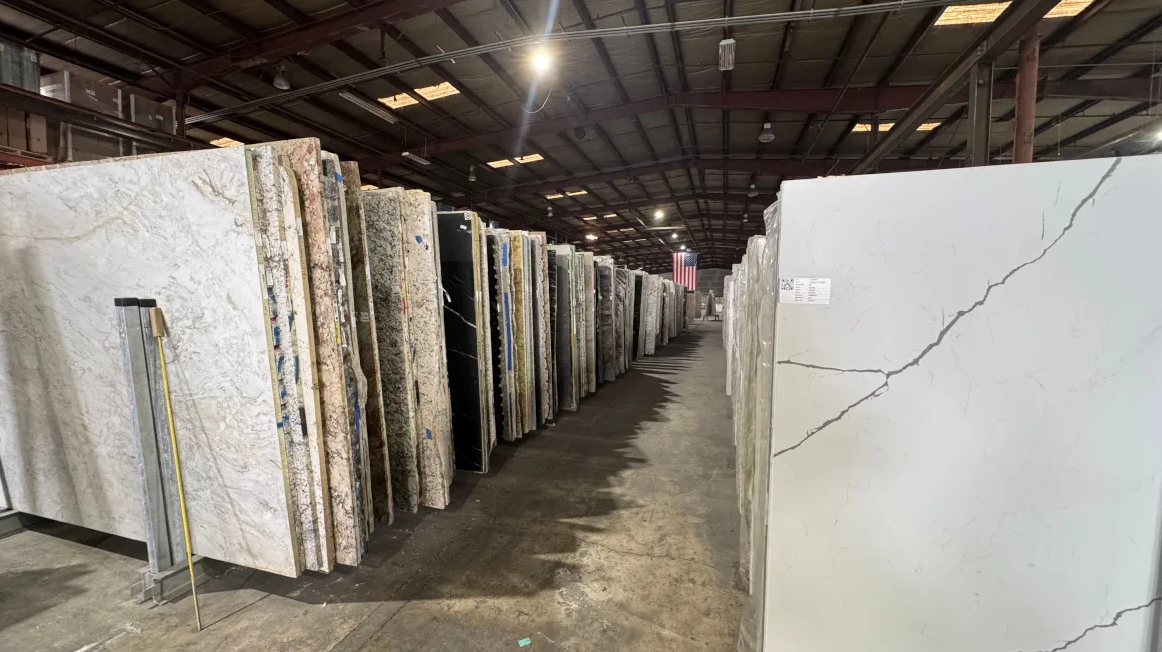
Digital templating helps you become more efficient in programming. That efficiency speeds up manufacturing. Having slab scanners helps us work with clients faster because instead of moving bundles around to help homeowners find their slab, we put them in front of a computer screen and let them scroll through images.
The cost of someone sitting at a computer looking through slab images is a lot cheaper than having my guys moving slabs around with forklifts.
So, the short answer is this: transition toward digital equipment. The digital in the field helps you become more efficient in programming. That efficiency in programming helps you speed up, hypothetically, your manufacturing. And having, like, hypothetically, a scanner helps us deal with clients faster because we are doing slab layouts. Instead of moving bundles to make the homeowner happy to find their slab, I put them in front of a computer screen and say, “Thumb through all of these.”
Why? The costs associated with somebody being on a computer screen, thumbing through images of slabs, are a lot cheaper than my guys with a forklift moving everything around, right?
So, the short answer to the long answer is transitioning more into digital equipment.
GV: I’m going to talk about where I come from and where I can help you guys. Basically, my job is to find capital for you so that you can buy the technology that will help you grow. I know that is kind of nerve-racking because you are taking on debt, you have to show your financials and you have to talk about money. It is very sensitive, and my job is to help you through that.
Back to Meghan’s question. I believe 2025 was a soft year for the stone industry. 2026 appears to be kind of neutral, maybe still a little soft. But I think 2027 and 2028 are going to get busy again.
So, where I’m going with that is, if you need equipment and you are thinking, “Okay, I need to jump into this now,” start thinking about it today. Without turning this into a marketing pitch, we are doing six-month skip financing. The reason I mention that is because I can help you get approved now. It takes months to get equipment. I can get you skips for six months, five months, whatever you need, so you can start planning now.
It may take nine months or a year before you actually get the equipment. If you wait until then, you are going to be behind the curve. That is the risk Meghan was asking about. Start thinking about the future now — knowing it is going to take a while to get to the place where you actually have that equipment.