Article
California Fabricators Cite Uphill Battle with Cal/OSHA as Biggest Challenge
Friday, November 6, 2026 from Stone World
Pacific Shore Stones welcomed area fabricators to its Fresno, CA, location for an all-day Stone Summit – focusing on Cal/OSHA silica regulations and overall shop safety
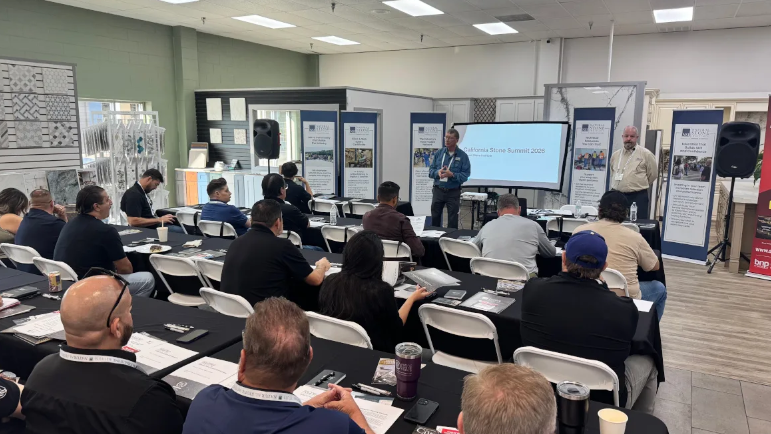
Approximately 30 fabricators showed up to discuss shop safety at the Stone Industry Education (SIE) event hosted by Pacific Shore Stones at its Fresno, CA, facility on Thursday, October 8, 2026. The talks were led by Jeff “Corky” Courtright, safety coordinator for Planet Granite, based in Colorado Springs, CO, and Mark Meriaux, technical manager of the Natural Stone Institute (NSI).
Courtright focused on enhancing workplace safety standards, best practices, regulatory updates and risk management strategies. He began the day’s presentation by ranking the top 10 Cal/OSHA citations – the number one citation being “Failure to implement effective dust suppression.”
Meriaux explained silica regulatory changes in California. He started by sharing the history between NSI and Cal/OSHA. “Backing up a few years, California, as a state, decided to tighten up the language beyond the Federal rules,” he said. “They had some very challenging [standards] for all of you fabricators. The rules are not easy to comply with now, but it was even worse on their first draft.”
NSI got involved to try to convince Cal/OSHA to make more reasonable rules. “In working with them over the last four or five years, I realize they also have a challenge at the government level,” Meriaux said. “I have gotten to know of those guys personally. They are extremely understaffed. I know, as a state, the budget is underfunded.”
Meriaux went on to outline where the current ban stands. “The first draft is proposed,” he said. “They received public comments at the end of last month. The next step is the Occupational Safety Board; they are supposed to vote on that.”
“As of this month’s current agenda, it is not shown as an agenda item,” Meriaux continued to explain. “We expect at the earliest, it may be November before that shows up as a vote, and the agenda items may be discussed or voted, or addressed through public comments.”
Meriaux said that then they have to draft a final text, which could be in the next three months. “We don’t know,” he said. “It could be six months; it could be a month. They are pushing to do this very quickly, so I anticipate it will be before the end of the year. But it could go into next year easily.”
Once the vote takes place, the current draft language says it has 60 days to take effect. “Then that would allow 180 days for you to get any of those high-crystalline artificial stone materials out of your stock,” said Meriaux. “There’s no method for reimbursement or compensation to anyone carrying a large stock of high-silica artificial stone material.”
Meriaux also brought up the uncertainty about how it would affect commercial projects. “For those with new commercial work, pre-existing contracts or major contracts that you are contractually obliged to complete those projects, there is supposed to be a time frame when those are addressed. They haven’t said whether that means the start of the project is within that 180-day period, or I imagine a big construction project could take six months or a year.
“We argued with them that it is not enough time,” Meriaux went on to say. “If you are contractually obligated in a project, you need a minimum of six months to a year to complete some of these bigger projects. Sometimes even longer.”
Final Thoughts
The California Stone Summit was one in a series of 10 organized by Stone World in partnership with NSI in strategic locations across the U.S. throughout the year. While the topic of discussions vary depending on the speaker and location, a primary objective of all the educational events is to unite fabricators for engaging conversations where they can learn from each other’s experiences and find solutions for their challenges together.
Courtright was pleased to see this happen at the California Stone Summit. “The most impressive thing I witnessed [at the event] was when I asked a younger gentleman who was there with his dad if he would talk to two other attending fabricators about working with porcelain,” he said. “The two gentlemen had told me they were having a hard time with it, and the younger fabricator has been doing it for eight years. I said, ‘I know they might be a competitor for you here in Fresno, but, we are all in this together.’”
Courtright explained that the young fabricator jumped up and went back there to talk to the other fabricators. “I was watching him,” said Courtright. “He was back there for about 15 minutes helping them solve their problems with cutting porcelain. That made my day. That’s what this is all about – helping each other. That was my highlight. I’m going to remember that forever.”
After the event, Meriaux shared that he was impressed at the number of fabricators who came out to learn about the silica regulatory changes in California because of the deeper understanding of how challenging it is to be in the fabrication business in California. “All of those 30 fabricators who were in the room are working diligently to stay above board and keep their businesses and their employees working positively, staying engaged and being productive fabricators,” he said. “It takes an immense amount of time and effort from the folks in California to run their businesses above board, correctly and legally. It was a huge investment of their time. And it will be a lot more time, energy and money that they’ll have to spend on and in their businesses to keep them operating in the state of California. I just hope that we have helped them be prepared to deal with that in the coming months.”
The final SIE event of 2026 is scheduled for Thursday, October 29th in Dallas, TX. For more details and to register, visit: www.stoneindustryeducation.com.