
Article
2026’s Sustainability Summit Tackles Tough Topics
Thursday, August 20, 2026 from Floor Covering Weekly
By Suzy Krogulski
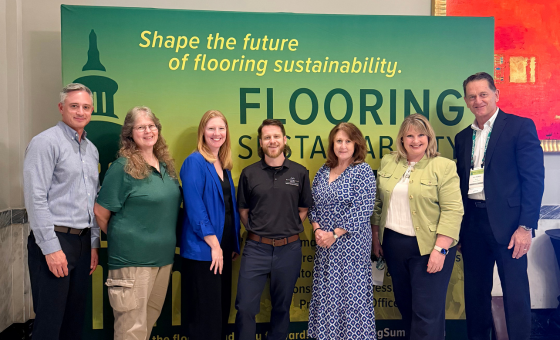
This year’s 2026 Flooring Sustainability Summit was held July 15 to 16 here in Washington, D.C. at The Mayflower Hotel. With a focus on bringing together participants, from manufacturer to designer, as well as discussing all types of flooring, the Summit empowered stakeholders to work towards making the entire flooring cycle more sustainable.
Summit Goals
Harmony Nikolla, association manager for North American Laminate Flooring Association (NALFA), shared, “The Summit focused on moving sustainability conversations toward practical action through greater transparency, circularity, durability, responsible product specification and collaboration across the flooring industry.”
To the LATICRETE team attending their third Summit, what stood out this year is how the Summit is becoming even more proactive. Samantha Rothberg, senior director of marketing communications reported, “This industry is no longer short on EPDs, HPDs and declarations. What it’s short on is the ability to find them, compare them, make an informed decision about product impact and put them into a specification without needing a translator. That’s the gap the Summit went after this year.”
Indeed, Rothberg noted the Summit had three overarching themes: Simplifying paperwork and decision-making; translating the jargon; and, connecting stakeholders across the full project life cycle.
Noah Chitty, vice president of sustainability and technical services, AHF Products, observed that the term “circularity” was one nebulous term tackled at the event. “Specifically, what it means and how we define it. There seemed to be a shared desire across the supply chain for a common language and a common set of expectations so everyone can work toward the same goals and move progress forward more quickly,” he said.
Stephanie Owen, president and CEO, National Wood Flooring Association (NWFA) saw an emphasis on communication, specifying making sustainability easier to understand and communicate. “We have good stories to tell, but we have to do a better job telling them. That was especially true from the wood flooring perspective,” she shared, highlighting wood’s position as an extremely sustainable flooring option.
Owen continued, “But we cannot assume people already understand those benefits. As an industry, we have both an opportunity and a responsibility to communicate them more effectively and authentically so architects, designers and consumers can make informed decisions.”
Alongside simplifying jargon, Mohawk’s senior director sustainability, Jonathan North, noted that collaboration was key at this year’s Summit, highlighting, “[Mohawk] wanted to hear from the environment at large, that there was understanding and acknowledgement that the things we are working on are also being tackled by the rest of the industry.”
North also commented that the Summit’s message emphasized anticipating end consumers’ needs, with the end user, he said, being the person living with the product.
This boiled down to, North said, “two overriding messages: Don’t lose sight of the customer, and don’t patronize with confusing language.”

Sustainable Accomplishments
With these goals in mind, the Summit’s attendees began conversing on how to accomplish them. Nikolla said that one of this year’s Summit’s greatest successes was “creating space for candid, cross-industry conversations among manufacturers, designers, contractors, installers, associations and other flooring professionals.”
Critical to this was collaboration. Said Chitty. “I was honestly struck by how many leaders at the top of their fields came together, not just to present, but to genuinely share ideas and learn from one another. I also noticed that many of the speakers stayed for other sessions and listened to their peers, which says a lot about the collaborative spirit of the event,” he said.
Chitty also noted, highlighting that different organizations have different understandings of sustainability, “[We left] with a better understanding of how different organizations think about circularity. I do not think there was any more clarity around one single definition, but hearing the different perspectives and understanding where everyone is coming from was really valuable. That kind of understanding makes collaboration a lot easier.”
North agreed that the flooring industry walked away with a new perspective. “I think it was broadly acknowledged by the flooring industry at large that our industry needs to take better care of product at end of life, that our clients want for us to take greater responsibility for flooring at end of life.”
Rothberg said that the Summit was able to move the focus on sustainability away from marketing, and into the specification workflow, sharing, “That sounds incremental. It isn’t. It is the difference between sustainability as a claim and sustainability as infrastructure; data that can be verified, uploaded, compared, specified and maintained over time. The industry made real progress around that this year.”
This was important, she reported, as the overall agenda was more about infrastructure, not products. They also highlighted that the architecture and design (A&D) community shared plainly its issues with the lack of a consistent approach and clarity around data management.
And this was explored, said Owen. “I think the biggest accomplishment was the quality of the dialogue across different parts of the industry and the A&D community. It is easy for each segment of the supply chain to have conversations within its own circle. The Summit created an opportunity to hear directly from people who manufacture products, specify them, sell them and install them, and evaluate their environmental impact.”
“Collaboration and communication are really the keys to success. I also came away thinking about how we talk about sustainability: The message has to fit the audience. There are times for technical conversations, but they are not appropriate for every audience. If we want to make progress, we have to communicate in a way that connects with people where they are.”
— Noah Chitty, AHF Products