
“It’s not a good story,” says Jan Freitag, national director of hospitality analytics, at CoStar Group of the hospitality market’s 2025 performance. “Room rates are bumpy, stuttering. Year-to-date in August, room rates were up 1%, which is less than inflation. If revenues rise by less than expenses, that means price pressure.”
Freitag notes that it’s “a story of bifurcation: the upper end is doing a lot better than the lower end. Room rates for luxury are up 2.9%, but for economy, down 1.2%, which means, at that level, there is no growth at all on the top line, but all expenses are higher.”
Of the six levels—economy, midscale, upper-midscale, upscale, upper-upscale and luxury—the bottom levels have declined by a larger percentage in room rates year over year.
“This isn’t as bad as the pandemic or the great financial crisis of 2008 to 2009 or September 11, but if you remove those recessionary periods, this walks and talks like a recessionary period,” he says.
There is a confluence of reasons why the U.S. hotel industry is not doing well, Freitag reports:
• The on-again/off-again tariffs have infused uncertainty in Fortune 2000 companies. Because they can’t foresee what input costs will be, they seek to control their margins by cutting expenses, including travel and training, which has eroded travel demand declines five months in a row.
• Leisure consumers are facing higher inflation, which leaves less for discretionary spending such as travel and tourism. This is why there has been deceleration on the lower-end scale.
• While the dollar is weaker than it was a year ago, that hasn’t fueled inbound travel. There are fewer international inbound travelers due to rhetoric from the Trump administration. “In particular, the rhetoric around Washington, D.C., is tough,” says Freitag. “Trump says it’s dangerous, which impacts corporate transient travel, leisure travel and international inbound travel.” Interestingly, there are 2% more Americans going abroad than last year. Airlines’ earnings call reports the premium passenger is still flying. Also, luxury room rates in many European countries are healthy.
Additionally, for the hospitality industry, labor is a challenge because a percentage of the workforce is foreign-born.
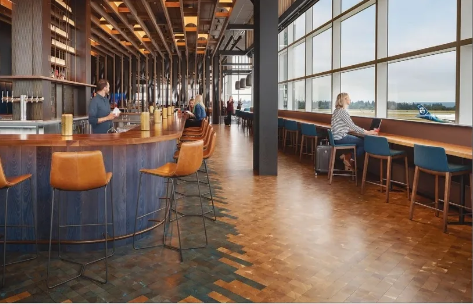
“Alaska Airlines Flagship Lounge, located in the Seattle-Tacoma International Airport in Sea-Tac, Washington, offers a view of the Olympic Mountains and downtown Seattle. Photo by Andrew Pogue.”
“The macro number, when September’s preliminary data comes out, will show two quarters of RevPAR (revenue per available room) decline with a high likelihood that Q4 will be negative too, due to the challenging comp of Q4 2024 when hurricanes devastated the Carolinas and people were displaced, which drove up occupancy,” says Freitag. “There is not an official definition of what a recession is for the hotel industry, but if I had to guess, I’d say two quarters is a good measure.”
The number of rooms in construction continues to decelerate with 137,000 year-to-date through September, so the industry is not overbuilding. That number stood between 150,000 and 160,000 for a decade. This is not good news for flooring manufacturers serving the sector.
“Building has slowed because interest rates are high,” explains Freitag. “It’s hard to get a loan, and hotels are inherently risky. The people lending today want a lot for their money. In addition, tariff costs for furniture, fixtures and equipment (FFE) are high, and then there is the lack of access to labor. All those things mean we aren’t building hotels. The asterisk is that all demand and supply are local, so there are markets—Nashville, Dallas, New York, etc.—with healthy number of new rooms, but those are the outliers.”
Planning for new rooms is fairly high, but some plans are in a holding pattern due to roadblocks with financing, land and costs—and some may have been in stasis for several years, so, ultimately, that figure could even be down by a percentage, says Freitag.
Acquisition activity for Q3 was around $4.3 billion, roughly a third below where the market was a year ago and $1 billion below Q2 2025. While 60% of the approximately 1,100 total acquisitions were for properties of less than $10 million, only 15% were over $100 million.
DESIGNER PERSPECTIVE ON ACTIVITY
Though renovation doesn’t paint a positive story, the sector’s overall activity level can feel different to design firms due to the nature of the work cycle. And, at times, less demand at the consumer end of the market can provide opportunity for renovation work.
“We haven’t felt a dip,” says Molly Dunn, senior designer with Parker-Torres Design. “However, where the rubber has met the road as of late is with budgets.” Dunn’s work is focused on four- and five-star properties.
“The one wild card seems to be the tariffs,” Dunn continues. “I don’t feel like budgets are changing, but they sort of have to. What we budgeted for lighting not long ago we now double, so we have to save money elsewhere.”
She adds that the extended nature of design timelines makes this especially complicated. “Between the time we get an RFP (request for proposal) to actually creating the design, so much time has passed and so many things have changed that it’s hard to come up with a realistic budget at the outset.”
Dunn reports that the majority of Parker-Torres’ current renovation work is at resorts. “We have a lot of work in Florida and Arizona. Activity definitely seems more leisure-heavy,” she says.
As for trends in the market with regard to activity, senior associate with ForrestPerkins Katherine Dalton reports, “Renovation dominates for sure. I would say new construction is more selective, with high-end and lifestyle leading growth. Owners are investing more in areas where guests connect, such as lobbies and wellness zones.” ForrestPerkins is Perkins Eastman’s luxury hospitality and residential interiors design studio.
Adds Sara Talleux, principal and hospitality interior design leader with DLR Group. “Right now, business activity at DLR Group is strong in both renovation and new construction, with a notable uptick in major new-build projects that had been on pause for several years. Regionally, the South and Southeast are seeing particularly high demand for new builds. While budgets are holding steady, they aren’t increasing at the same rate as costs due to tariffs, so value and efficiency are strong considerations.”
She continues, “In new construction, growth is focused on city centers and rural areas where demand for rooms is strong, while renovations are concentrated in larger urban centers. Brands are expanding and differentiating their offerings—particularly in the Southeast, Texas and Arizona, where population growth is fueling demand. Urban properties are adapting and expanding, and there’s fresh offerings and reinvention across existing hotels.”
Marcio Decker, founder and lead creative at Aspen Leaf Interiors, says, “I am also seeing large properties like the Caesar’s Tahoe being completely renovated with key brand-name restaurants being used to anchor the rebranding of the property. My pulse in Las Vegas—I have an office there—is that, of the large hospitality brands, Fontainebleau was the last that made a big boom. It’s spectacular. But that was in December 2023, and I can’t think of any properties that made a boom in 2025.”
Elizabeth Von Lehe, principal and senior design leader at CannonDesign, adds, “From what I have heard directly from the industry, for some of the big brands—Accor, Hilton and Marriott—adaptability is a throughline. Many brands aren’t doing a lot of new builds but a good amount of refreshing and adapting brands. In this, materials like flooring have a big role. Strategic enhancements can make a space feel new or relevant for a new consumer. They are adapting properties they already have, and that’s an opportunity for FFE.
While there has been a bit of slowdown due to economic uncertainty, what I have been seeing is a bit more creativity and interest in creative brand development and execution. The AutoCamp brand for Hilton is an example—and you can find some version of that with most of the large brands. It will never be their bread-and-butter, but it is their bleeding edge for something different.”